If you just got engaged and you're trying to figure out which wedding app to use, here's the honest answer: The Knot and Zola solve different problems, and most couples end up using one of them alongside a dedicated planning tool like Eydn. This guide breaks down exactly what each wedding platform does well, where each one falls short, what their privacy policies actually say about your data — a comparison nobody else seems willing to publish — and how to choose without wasting time on the wrong one.
The short answer
- Use Zola if you want a clean, modern experience with a native wedding registry built in.
- Use The Knot if you need deep wedding vendor search and don't mind a busier interface.
- Add Eydn if you want all your planning, tasks, budget, and AI in one place — and you'd rather pay $79 once than deal with a platform funded by the vendors it's recommending. (The full head-to-heads: Eydn vs Zola and Eydn vs The Knot.)
- Most couples don't need all three. Read on to figure out which combination makes sense for yours.
What each wedding platform actually is
The Knot
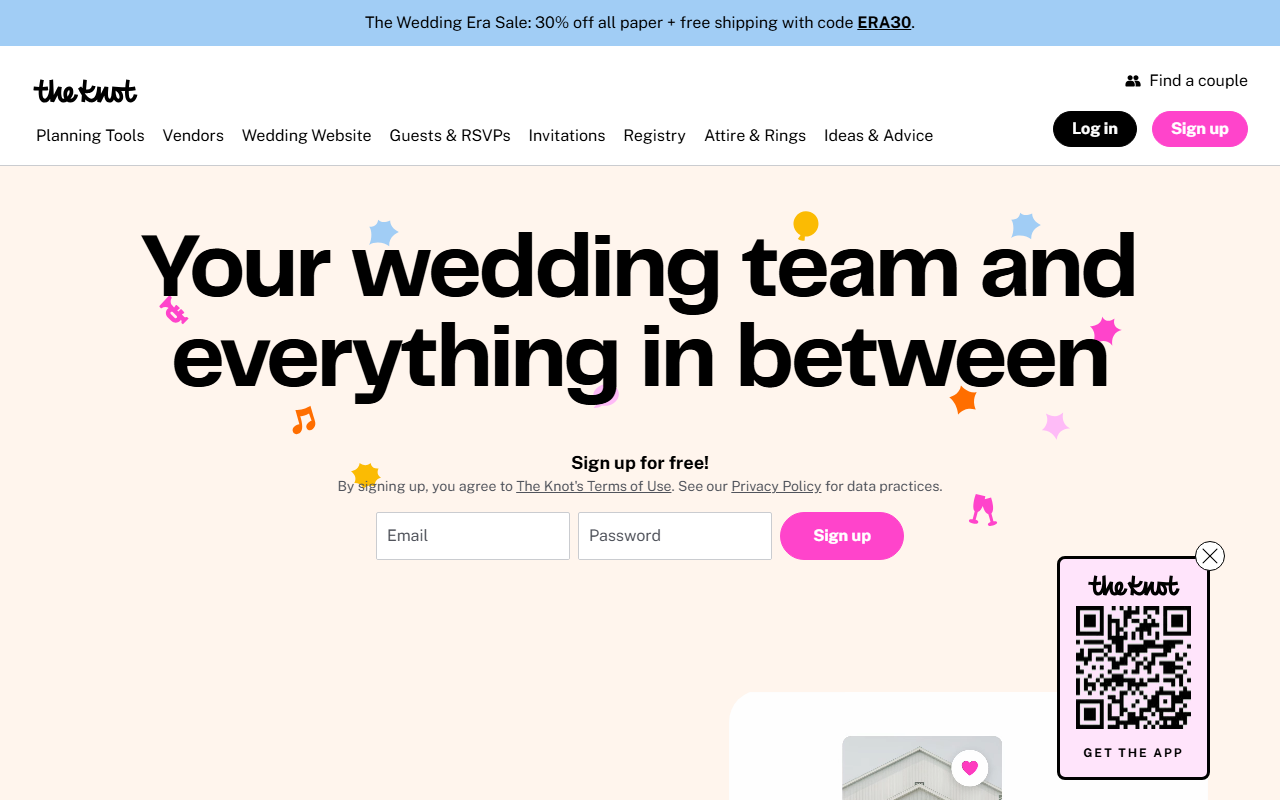
The Knot homepage, captured July 16, 2026.
The Knot has been around since 1996, and it shows — in a good way for vendor depth, in a mixed way for everything else. It has the largest wedding vendor directory in the US, a solid planning checklist, 380+ website templates, and active community forums.
The catch: The Knot is free because vendors pay to be listed — advertising tiers reported from about $125/month to $1,000+/month in competitive metros, typically on annual contracts. That means the vendors showing up first in search results aren't necessarily the best ones in your area. They're the ones paying the most. The interface reflects this: it's busier than it needs to be, and a lot of what you see is there because someone paid for it to be there. That's not a reason to avoid it — it's just worth knowing before you treat its recommendations as neutral. (Our comparison of nine wedding vendor marketplaces covers this dynamic across the whole industry.)
Zola
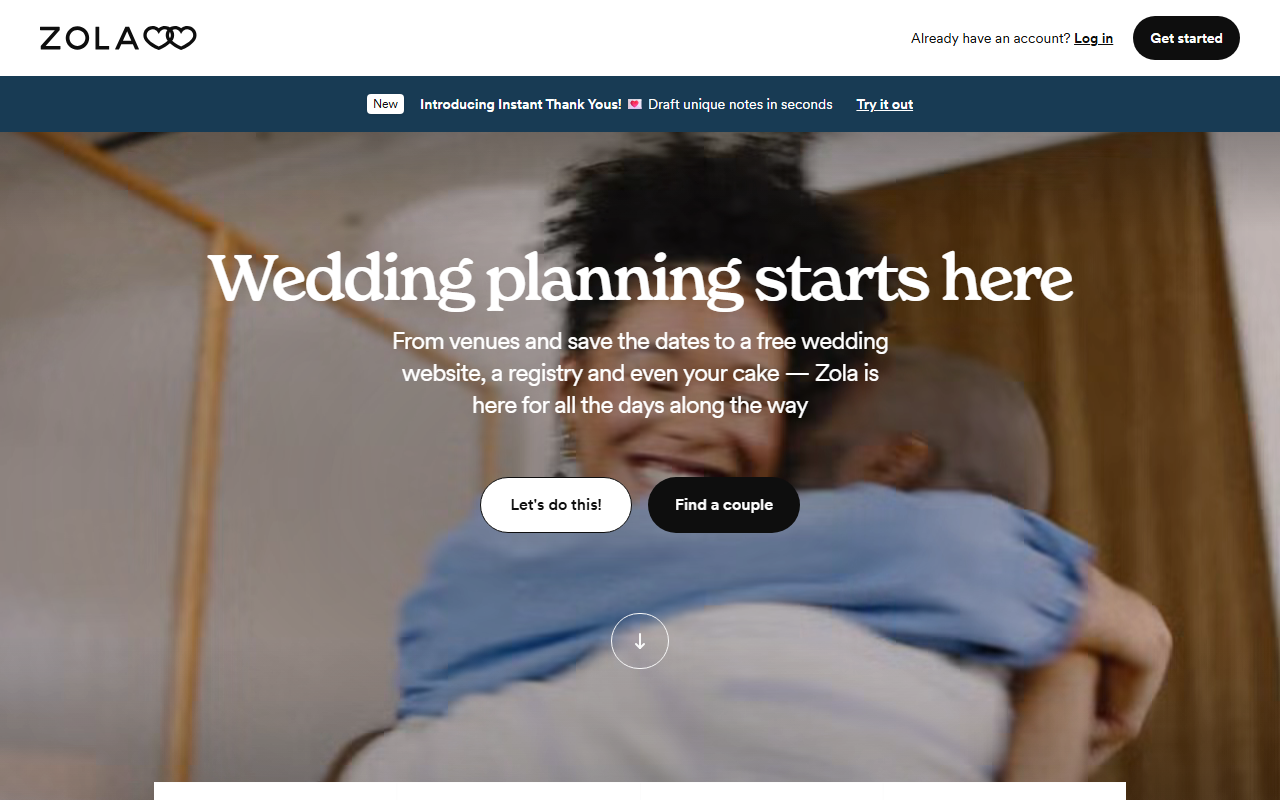
Zola homepage, captured July 16, 2026.
Zola launched in 2013 with a registry-first approach and has grown into a full wedding planning platform. The design is cleaner, the onboarding is faster, and the native registry is genuinely better than anything The Knot offers — guests browse and buy directly on Zola rather than being redirected to a dozen different retailer checkouts. Zola's core revenue is commerce: registry commissions and margins on stationery, with vendor marketplace fees as a smaller line.
The tradeoff: Zola discontinued its Android app in early 2023, so Android users are on mobile web. The wedding vendor directory is also smaller than The Knot's, which matters more in mid-size and rural markets.
Eydn
Eydn is a different kind of tool — an AI-powered wedding planning app built for the couple, not the vendors. For a one-time payment of $79, you get everything in one place: 50+ tasks auto-generated from your wedding date, a full budget tracker, vendor management, guest list, seating chart, wedding website, and an AI planner that actually knows your wedding and takes action when you ask.
The difference that matters: Eydn charges couples $79 because that's the only way to build something that works entirely for you. No vendor revenue. No one paying to influence what your AI recommends. If The Knot is a vendor marketplace that happens to have planning tools, Eydn is a planning tool with no financial reason to push vendors at you.
Wedding feature matrix: The Knot vs Zola vs Eydn
| Feature | The Knot | Zola | Eydn |
|---|---|---|---|
| Price | Free (ad/vendor-funded) | Free (commerce-funded) | $79 one-time |
| Wedding website | 380+ templates | Fewer, higher quality | Included in full suite |
| Native registry | Aggregator only | Yes — guests buy on Zola | Link out to Zola/Amazon |
| Wedding vendor directory | Largest in US (paid placement) | Smaller | AI-assisted search, no paid placement |
| Guest list + RSVPs | Yes | Yes | Yes, integrated with AI |
| Budget tracker | Basic | Basic | 36 pre-built line items |
| Seating chart | Yes | Yes | Yes, drag-and-drop |
| AI planning tools | No | No | Yes — takes real action |
| Android app | Yes | Discontinued early 2023 | Web app, all devices |
| Custom domain | Paid upgrade | Paid upgrade | Included |
| Cash gifts processing fee | ~2.5% | ~2.5% (flexible) | N/A |
| How rankings/recommendations are funded | Vendor advertising | Commerce + some placement | No vendor revenue |
| Sells/shares data for targeted ads (per privacy policy) | Yes* — opt-out available | Yes — opt-out available | No — Pledge |
*The Knot's own wording: disclosures to advertising partners "may be considered a 'sale' under applicable laws." Zola's policy answers "Yes" directly to selling or sharing identifiers with advertising partners. Both characterizations quote the policies linked in the privacy section below, as reviewed July 2026.
Wedding registry and gifts: where The Knot and Zola differ most
This is where the two platforms diverge most clearly. The Knot's registry is an aggregator — it pulls in products from Target, Crate & Barrel, Amazon, and others into one view, but guests check out on the original retailer's site. It works. It's just not elegant.
Zola's registry is native. Guests browse and buy directly on Zola from one catalog. Cash funds, group gifting, and a 20% post-wedding completion discount are all genuinely well-built. Both platforms charge around 2.5% for cash gift processing via credit card, though Zola offers more flexibility — couples can choose whether guests or they themselves absorb that fee. If registry experience matters, Zola wins, and it isn't close.
Eydn doesn't have a registry — by design. The recommendation is to link out to Zola, Amazon, or Honeyfund and keep all your planning in Eydn. Most couples find this combination works well: Eydn for everything planning-related, Zola for the gifting experience.
Wedding vendor search on each platform (and who pays for placement)
The Knot's vendor directory is the deepest in the industry — every category, every US market, with review volume nothing else matches. But placement is sold: paid advertising tiers determine who appears first, so treat default sort order as an ad ranking, not a quality ranking. Sort by reviews, read the recent ones, and verify finalists off-platform.
Zola's directory is thinner but growing, and Zola shows vendors when a couple books someone else — a transparency feature vendors themselves praise. For categories where quotes vary widely, know the going rates before you compare: our wedding catering cost guide is the worked example, and the nine-marketplace comparison maps who pays what across every major platform.
Eydn's AI searches the open web and public reviews with no advertiser in the loop — results are ranked by fit, because no vendor can pay for position.
What about data privacy on these wedding platforms?
Almost nobody puts this in a comparison post, so here it is. Planning a wedding means handing a platform your name, your partner's name, your date, your venue, your guest list with addresses, and a working map of your budget. That's unusually valuable data, and how each company treats it follows directly from how each company makes money.
The Knot (per its privacy policy, effective April 2026) discloses that it shares personal information with advertising and analytics partners for targeted advertising, and acknowledges this "may be considered a 'sale' under applicable laws" — its words, not ours. When you inquire with a vendor, The Knot passes along your contact details and the contents of your message, and from that point the vendor's own privacy policy governs what happens to them. Marketing partners — "retailers, other program participants, or other third-parties" — can also receive contact and demographic data.
Zola (per its privacy policy, updated October 2025) answers plainly that it sells or shares personal identifiers, internet activity, and commercial information with advertising partners, and shares booked-vendor information so vendors "can understand which Zola users have used their services." Because Zola is a commerce business, your purchase behavior is part of the data picture too.
None of this is scandalous — it's the standard economics of free platforms, and both companies offer opt-outs (use them: look for "privacy choices" or the Privacy Center in account settings, and consider a dedicated wedding email address). But it's worth naming plainly: on a free wedding platform, your data is part of how the bill gets paid.
This is the entire reason the Eydn Pledge exists. Eydn charges couples $79 so it never has to monetize your guest list, your budget, or your inbox. No data sales, no ad networks, no vendor kickbacks — and if we ever break that, every customer gets a refund. When the product is paid for directly, the data can just be yours.
Wedding planning tools and AI compared
The Knot has a solid checklist and budget tracker. They're useful but passive — they tell you what to do, they don't help you do it. Zola's planning tools are similar: functional, not proactive.
Eydn's AI planner is different in kind, not just degree. It knows your budget, your guest list, your vendors, and your timeline. You can ask it anything — it adds guests, tracks spending, searches for vendors in your area, and tells you what needs your attention this week. When you fall behind, it builds a catch-up plan. When your budget drifts, it flags it and suggests where to reallocate. It's not a chatbot. It's a planner that takes action.
Wedding platform pricing: what "free" actually costs
The Knot and Zola are both free to use, with optional costs for custom domains (~$20), printed invitations, and cash gift processing fees (~2.5%). The non-optional cost is the one covered above: advertising-funded platforms are paid for with your attention and your data, and vendor-funded directories are paid for with placement fees that shape what you see.
Eydn is $79 one-time — every feature, no subscription, no upsells. Most couples spend $33,000+ on their wedding. $79 for a planning tool that works entirely for you is a straightforward value calculation.
Pros and cons of each wedding platform
The Knot — pros
- Largest wedding vendor directory in the US, searchable by location, budget, and style
- Comprehensive planning checklist and budget tracker
- 380+ free website templates with RSVP tools built in
- Advanced customization and design flexibility
- Matching stationery and paper goods available
The Knot — cons
- Interface cluttered with ads and vendor promotions
- Vendor rankings reflect paid placement, not independent quality
- Registry experience fragmented across multiple retailer checkouts
- Privacy policy permits data sharing for targeted advertising (opt-out available)
Zola — pros
- Clean, modern interface with fast setup
- Native registry with cash funds, group gifting, and 20% completion discount
- Guest tools — address collection, RSVP, communications — all in one place
- Personal wedding advisors at no extra cost
- Shows vendors when you've booked someone else — unusually transparent
Zola — cons
- Android app discontinued since early 2023
- Smaller wedding vendor directory in mid-size and rural markets
- No AI planning tools
- Privacy policy confirms sale/sharing of identifiers with ad partners (opt-out available)
Eydn — pros
- Everything in one place — tasks, budget, vendors, guest list, seating chart, website
- AI planner that knows your wedding and takes real action
- $79 one-time — no subscription, no vendor revenue influencing recommendations
- No data sales or ad networks — the Pledge, refund-backed
Eydn — cons
- No native registry — link out to Zola, Amazon, or Honeyfund
- $79 upfront vs. free on The Knot and Zola
Which wedding platform should you choose?
If you want a strong free registry and clean design — Zola is the better-designed option, and the gifting experience is genuinely excellent.
If you need to research a lot of local wedding vendors — The Knot's directory is unmatched. Just remember that rankings reflect paid placement, not independent quality.
If you want everything in one place with an AI that actually does the work alongside you, and a platform with no financial reason to steer you toward any vendor — Eydn is the $79 you'll spend more confidently than almost anything else in a $33,000 wedding.
Most practical combination: Eydn for planning, Zola for registry. Most couples don't need anything else.
Frequently asked questions
Is The Knot or Zola better for wedding planning overall?
The Knot wins on vendor search depth (the largest wedding vendor directory in the US); Zola wins on registry and design. Neither has strong proactive planning tools — both give you checklists rather than help doing the work. Many couples pair one of them with a dedicated planning tool and use the platform only for its strongest feature — our Eydn vs Zola and Eydn vs The Knot pages cover exactly that pairing, and our best wedding planning apps guide compares the whole field.
Do The Knot and Zola sell your data?
Both companies' privacy policies acknowledge activity that qualifies as a "sale" or "sharing" of personal information under state privacy laws like the CCPA, mainly for targeted advertising. The Knot's policy says disclosures to advertising partners "may be considered a 'sale' under applicable laws"; Zola's policy answers "Yes" to selling or sharing personal identifiers and internet activity with advertising partners. Both offer opt-outs in their privacy settings — worth doing on day one.
Can I use both The Knot and Zola for my wedding?
Yes, and most couples do use more than one platform. That said, running both for your wedding website or registry confuses guests. Choose one platform for your main website and registry — and keep your primary planning in whichever tool you commit to first.
Is it hard to switch wedding platforms once I've started?
Switching your main planning tool mid-planning is painful. Your data, guest list, and shared links all have to move. Try platforms early — before you commit any URLs to printed materials — and commit once you've tested the tools that matter most to you.
How long will my wedding website stay online?
The Knot keeps free sites live for roughly a year after the wedding. Zola tends to maintain archives longer but reduces editing options. Download your guest data and important content before either platform's retention window closes — and back everything up independently regardless.
Who owns the data I put into these wedding platforms?
You retain rights to your content on all three platforms, but each grants certain usage rights in their terms of service, and the free platforms monetize data through advertising partners (see their privacy policies). Read the current policies before uploading sensitive information or professional photos. Eydn's model — charging couples directly — means your data isn't the product.
Ready to plan with a tool that answers only to you? Eydn gives you tasks, budget, vendors, guest list, seating chart, and a wedding website — all in one place, with an AI planner that knows your wedding and takes action when you ask. One-time $79, no subscription, no vendor influence. Start your free 14-day trial.