The Wedding Day Timeline
Your wedding day timeline is the single document that determines whether the day feels relaxed or rushed. Below you'll find sample schedules for ceremonies from 2 pm to 5 pm, and practical timing advice for every block, from the moment makeup begins to your grand exit.
Key Takeaways
- A wedding day timeline is an hour-by-hour plan covering hair and makeup, ceremony, portraits, reception milestones, and the send-off.
- A typical wedding day lasts between 8 and 12 hours from first alarm to last dance.
- Creating a wedding day timeline is essential for a stress-free experience — it keeps your wedding party, vendors, and family photos on track and protects fixed moments like your ceremony start and cake cutting.
- This article includes four sample wedding timeline schedules for 2 pm, 3 pm, 4 pm, and 5 pm ceremonies.
What a Wedding Day Timeline Is (and Why It Matters)
A wedding day timeline is a minute-by-minute schedule covering everything from the moment your bridal suite fills up with coffee and curling irons to the sparkler send-off at the end of the night. It aligns every person — couple, bridal party, vendors, and immediate family — around the same set of fixed and flexible moments. The ceremony time influences the overall schedule of the day, and every other block radiates outward from it.
A solid timeline prevents delays and keeps events on track. Without one, common problems stack up fast: the bride's hair runs 45 minutes over, the photographer arrives at an empty room, family portraits eat into cocktail hour, sunset photos get skipped entirely, and dinner service hits the table cold. Weddings commonly last five to six hours from ceremony to reception end, but the full wedding day itinerary, including morning prep and travel, typically stretches 8 to 12 hours.
How to Use This Wedding Day Timeline Template
The template below is a practical, plug-and-play starting point you can use in Google Sheets, Excel, or any planning tool. It's organized into discrete blocks that you fill in based on your own ceremony time, venue, and wedding party size.
Template Structure
- Getting ready – hair and makeup, getting dressed, wedding attire steaming
- Photographer arrives – detail shots (rings, invitation suite, shoes), candids
- First look (if applicable) – private reveal, couple portraits
- Ceremony – processional, vows, recessional
- Cocktail hour – guests entertained, wedding party group photos, or family portraits
- Reception events – grand entrance, dinner service, wedding party toasts, cake cutting, first dance, parent dances, open dance floor, sunset portraits, last dance, grand exit
How to Customize It
- Enter your ceremony start time and reception end time.
- Work backward to set hair and makeup durations, photographer arrival, and travel blocks.
- Add 10 to 15 minutes of buffer time between major moments, especially around family photos and the grand entrance.
- Adjust portrait blocks based on whether you're doing a first look.
- Print a one-page version for the wedding party (key times only) and save the detailed timeline for vendors who need load-in notes and setup windows.
Key Timing Building Blocks for Any Wedding Day
| Block | Typical Duration |
|---|---|
| Wake-up and breakfast | 30–60 minutes before stylists arrive |
| Hair and makeup | 60–90 minutes per person; ~30 minutes per person with multiple artists working in parallel |
| Getting dressed | 20–30 minutes (more for buttons, bustles, or layers) |
| Photographer arrives / detail shots | 60–90 minutes |
| First look | 15–20 minutes, then roll into portraits |
| Travel time | Varies — add realistic blocks between every location change, including parking |
| Ceremony | 20–60 minutes (civil: 20–30 min; religious: 45–60 min) |
| Cocktail hour | 60–90 minutes |
| Sunset photos | 15–20 minutes during golden hour |
| Reception milestones | Most receptions run four to five hours |
| Grand exit | 10–15 minutes including setup |
Buffer time is essential to avoid rushing through moments. Add 10 to 15 minutes between any block where you're moving people or changing locations.
Hair and Makeup: Setting the Pace of Your Morning
Hair and makeup usually determine how early the wedding party's day starts, and most couples underestimate how long it takes.
- Bride: 60–75 minutes for formal hair, 60–75 minutes for makeup (roughly 90 minutes total with overlap)
- Bridesmaids/family members: 30–45 minutes per service
- Flower girls: 15–20 minutes
With two makeup artists working in parallel, a bridal party of five plus the bride can be ready in about 4–5 hours. With a single stylist, that same group may need 6–8 hours, meaning an uncomfortably early alarm.
Working backward from ceremony time: For a 4 pm ceremony with a first look at 2 pm, the photographer arrives around 1 pm for detail shots. The bride needs to be camera-ready by 12:30 pm. That means makeup begins no later than 11 am, and the first bridesmaid sits down for hair around 8:30–9:00 am.
Tips
- Do trial runs with stylists beforehand so timing estimates are accurate
- Seat bridesmaids first; the bride goes last, so her look stays fresh
- Build in a 30-minute buffer before leaving the bridal suite
Photography Timing: Couple Portraits, Wedding Party, and Family Photos
Photo timing is the backbone of your wedding timeline. Decisions about first look, family photos, and sunset portraits directly shape how the rest of the day flows.
- Couple portraits: 30–45 minutes
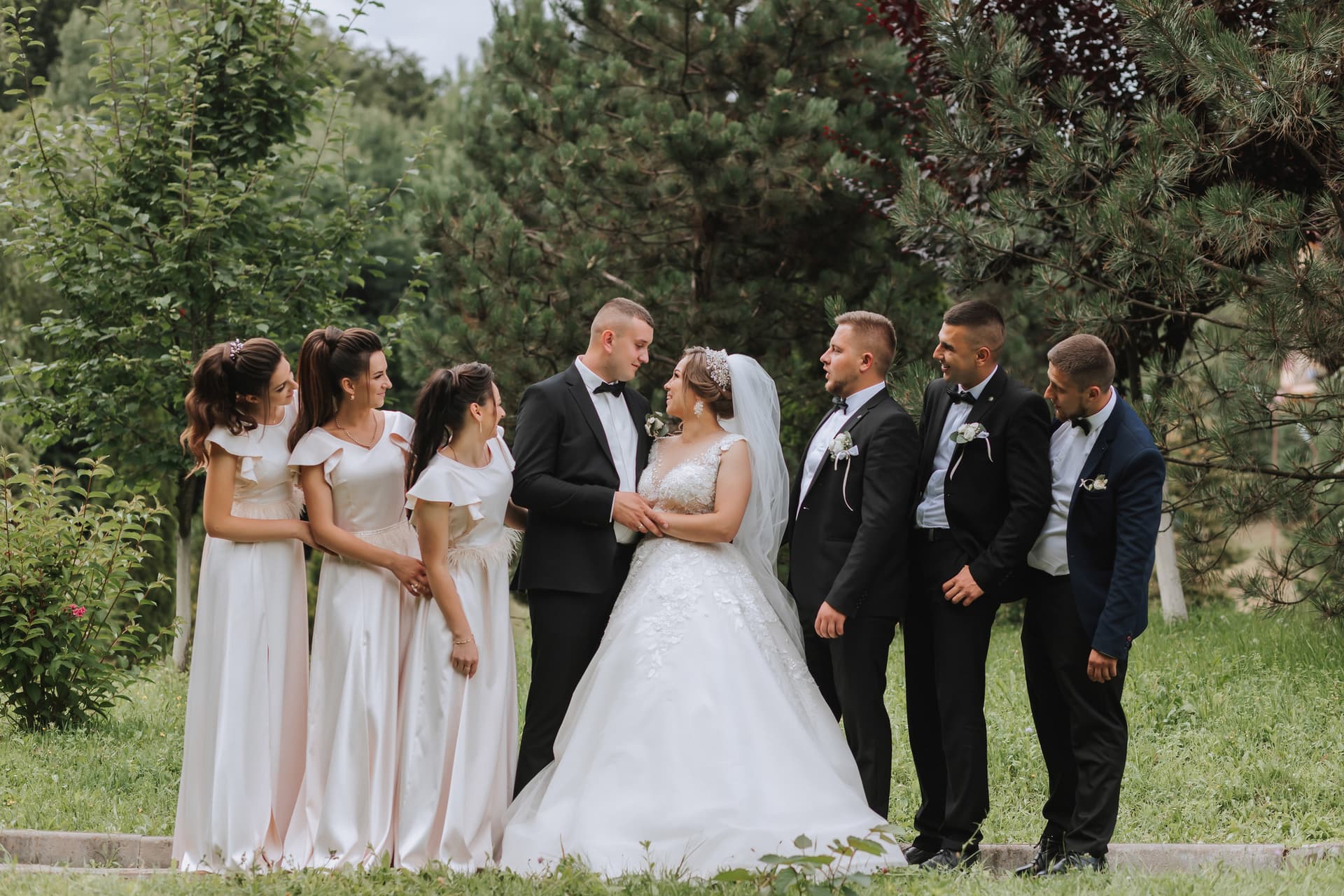
- Wedding party portraits: 30 minutes (longer for large parties)
- Family portraits: about 5 minutes per group, suggested max of 10–15 groups
Photo order strategy: Start with detail shots when the photographer arrives (rings, shoes, invitation suite, flat lays), then getting-ready candids. If doing a first look, couple portraits follow immediately, then wedding party photos, then family photos (before or after the ceremony).
Sunset photos and golden hour: Look up your exact sunset time for your wedding date. If sunset is at 7:30 pm in summer, plan to step out of the reception around 7:10 pm for 15–20 minutes of portraits in natural light. Let your DJ or coordinator know so they can keep guests entertained during the break.
First Look vs. No First Look: How It Changes Your Timeline
A first look is a private moment where the couple sees each other before the ceremony. Photographers often recommend it for reduced stress and more flexible photo opportunities.
With a First Look
- Most portraits happen pre-ceremony
- The couple can actually enjoy cocktail hour and greet guests
- Post-ceremony time is freed up for only a few additional family groupings
- The day has more breathing room overall
Without a First Look
- All portraits move into the cocktail hour window or the early gap after the ceremony
- The couple typically misses most of cocktail hour
- A compressed post-ceremony schedule can push back the grand entrance and dinner
- More pressure on the photographer to work quickly
Concrete comparison: With a 3 pm ceremony and a first look at 1 pm, couple and wedding party portraits wrap by 2:15 pm, leaving a 45-minute buffer. Without a first look, you'd need 40–60 minutes post-ceremony for portraits, pushing back cocktail hour and risking a conflict with sunset photos.
Sample Wedding Day Timelines by Ceremony Time
Each sample assumes a ceremony and reception at the same venue with minimal travel and about 100–120 guests.
2 pm Ceremony (First Look, Early Afternoon Wedding)
- 7:30 am – Hair and makeup begin for the bridal party
- 11:00 am – Photographer arrives, detail shots
- 11:30 am – Getting-ready candids, wedding attire photos
- 12:00 pm – First look + couple intimate portraits
- 12:30 pm – Wedding party portraits + family photos
- 1:30 pm – Buffer / bridal party refreshments
- 2:00 pm – Wedding ceremony
- 2:30 pm – Cocktail hour begins, additional family portraits
- 3:30 pm – Grand entrance into reception space
- 4:00 pm – Dinner service begins; toasts between courses
- 5:00 pm – Cake cutting, first dance, parent dances
- 5:30 pm – Dance floor opens; sunset portraits if light allows
- 7:00 pm – Last dance and grand exit
3 pm Ceremony (First Look)
- 8:30 am – Makeup begins for the bridal party
- 12:00 pm – Photographer arrives for detail shots
- 1:00 pm – First look + couple portraits
- 1:30 pm – Wedding party group photos
- 2:00 pm – Family photos (immediate family groups)
- 2:30 pm – Buffer, final touch-ups
- 3:00 pm – Wedding ceremony
- 3:30 pm – Cocktail hour begins; guests arrive at reception space
- 4:30 pm – Grand entrance
- 5:00 pm – Dinner service
- 6:00 pm – Wedding party toasts, cake cutting
- 6:30 pm – First dance, parent dances
- 7:00 pm – Open dance floor
- 7:30 pm – Sunset portraits (step out for 15 minutes)
- 8:30 pm – Last dance and grand exit
4 pm Ceremony (No First Look)
- 9:00 am – Hair and makeup begin
- 1:30 pm – Photographer arrives, detail shots and getting-ready photos
- 2:30 pm – Wedding party portraits (without couple)
- 3:15 pm – Buffer; guests arrive, ushers fill all the seats
- 4:00 pm – Wedding ceremony
- 4:30 pm – Cocktail hour begins; couple + family portraits during cocktail hour
- 5:15 pm – Couple's intimate moments and remaining family groupings
- 5:30 pm – Grand entrance
- 6:00 pm – Dinner service; wedding party toasts between courses
- 7:00 pm – Cake cutting, first dance, parent dances
- 7:30 pm – Dance floor opens
- 7:45 pm – Sunset portraits during golden hour
- 9:00 pm – Last dance
- 9:15 pm – Grand exit
5 pm Ceremony (First Look, Evening Wedding)
A 5 pm ceremony is popular for evening weddings and pairs well with an extended reception that runs into the night.
- 10:00 am – Hair and makeup begins; start earlier if the bridal party is larger than five
- 2:00 pm – Photographer arrives, detail shots
- 2:30 pm – Getting-ready candids
- 3:00 pm – First look + couple portraits
- 3:30 pm – Wedding party portraits, family portraits
- 4:30 pm – Buffer, final timeline check with wedding coordinator
- 5:00 pm – Wedding ceremony
- 5:30 pm – Cocktail hour begins
- 6:30 pm – Grand entrance into reception space
- 7:00 pm – Dinner service
- 8:00 pm – Wedding party toasts, cake cutting
- 8:30 pm – First dance, parent dances
- 9:00 pm – Dance floor opens for extended reception
- 10:30 pm – Last dance
- 10:45 pm – Grand exit
Editing the Timeline Template to Fit Your Wedding Party and Vendors
The template is a starting point. Your final timeline depends on guest count, number of speeches, travel distances, and cultural traditions.
- Larger wedding party = earlier hair and makeup. Six bridesmaids instead of four may mean starting 60–90 minutes earlier or adding a second stylist.
- Bigger families = longer family photos. Each additional group adds roughly 5 minutes. Fifteen groups means 75 minutes, not 45.
- Religious ceremonies or cultural rituals (tea ceremony, ketubah signing, baraat) need separate blocks with confirmed durations from your officiant.
- Vendor coordination: ask your photographer for the minimum portrait time, confirm dinner service length with your caterer, and give your DJ the exact order and timing for grand entrance, toasts, and dances.
Timeline creation cadence: Finalize your timeline about a month before the wedding. Lock the finalized version one week prior to all vendor input.
Sharing Your Wedding Day Timeline: Guests, Wedding Party, and Vendors
Even a perfect wedding itinerary only works if everyone who needs it actually has it.
- Vendor timeline: Detailed, minute-by-minute, with load-in times, meal breaks for staff, and technical setup windows
- Wedding party one-pager: Key times only — when to arrive at the bridal suite, when photos start, when to line up for processional, grand entrance cue
- Guest-facing version: A simple "order of the day" on your wedding website or a welcome sign at the ceremony venue
How to share: Email the timeline to vendors and print copies for your wedding planner or coordinator. Share the finalized timeline with all vendors at least two weeks prior. Assign a point person — your planner, coordinator, or a trusted, organized friend — who watches the clock and adjusts on the fly. The couple should never be the ones checking the time.
Day-of Flexibility: What to Do If Your Wedding Timeline Slips
Even the best wedding schedule can run late. Traffic, a speech that goes long, a wardrobe issue, a vendor who can't find parking — these things happen. Planning ahead for slippage is part of smart timeline creation.
Anchors That Should Rarely Move
- Ceremony start time (guests arrive and are seated)
- Dinner service (caterers' timing is precise)
- Grand entrance (DJ and venue are cued)
- Any venue curfew
Recovery Strategies When You're Behind
- Compress group photos: drop posed shots for extended family, keep immediate family only
- Shorten wedding party toasts by one speaker or set a 3-minute cap
- Slide sunset photos by 10 minutes instead of delaying dinner
- Skip a formal activity (bouquet toss, garter) if the dance floor is already open
Example: You're running 20 minutes behind after family photos. Instead of pushing the grand entrance back, compress the cocktail hour by 10 minutes and trim one family group. The first dance and parent dances stay on schedule, and your reception timeline recovers before dinner.
FAQ: Wedding Day Timeline Template & Planning Questions
How early should I start building my wedding day timeline?
Start planning as soon as your venue and ceremony time are booked, usually 8–12 months out. A rough template helps you coordinate vendor bookings and identify scheduling conflicts. Finalize the timeline at least one month before the wedding, with a locked version sent to all vendors one week prior.
Do I need separate timelines for vendors and the wedding party?
Yes. Vendors benefit from a detailed, minute-by-minute timeline with notes about load-in, technical needs, and staff meals. Your wedding party needs a simpler one-page overview with key times: when makeup begins, when to be dressed, photo call times, and grand entrance cue.
How do I plan a wedding timeline for multiple locations?
Add realistic travel blocks between your getting-ready location, ceremony venue, and reception space. Include parking time and traffic buffers, especially for weekend or early afternoon ceremonies in busy areas. Share exact addresses and departure times on the timeline with all vendors.
What's the best way to include cultural or religious traditions in my timeline?
List every tradition — tea ceremony, ketubah signing, baraat, unity candle — with estimated durations, and insert them as separate blocks in the template. Work closely with officiants and family elders to confirm the order and time each ritual requires.
Can I change my wedding timeline after sending it to vendors?
Small tweaks are common in the final week, but major shifts should be avoided once vendors have staffed and planned around the schedule. Group late adjustments into one consolidated update instead of sending constant small changes.